Case Study · Copley · 2024–2025
Manual to agent: Designing the brief that designs itself.
Three generations of a brief flow. And the insight that users weren't filling out a form — they were trying to have a conversation.
Role
Product Designer
Timeline
2025–2026
Team
Angela Lin · Mike Torra (CTO) · David Henriquez (CEO) · Kevin McNerney (Principal SWE) · Maddie Daly (Staff SWE)
Tools
Figma
Overview
Copley is an AI-native marketing platform that helps brands create, test, and optimize ad campaigns at scale. As the sole product designer, I owned the end-to-end design of the Brief Wizard — the core flow where clients translate creative intent into AI-generated ad campaigns. Over the course of a year, I took it through three generations, moving from a rigid structured form to a fully conversational AI agent.
The problem
Ad creation was manual, linear, and started from zero. How do we make it iterative, intelligent, and agent-driven?
The Problem
Users weren't navigating the wizard the way it was designed. They were skipping fields, going back and forth, and treating the one free-text field as a chat box. They'd type, generate, review, retype. They had turned a brief into a conversation. My job was to make the product catch up.
Gen 1 — Mid 2025
Structure over expression.
Gen 1 — Brief Form
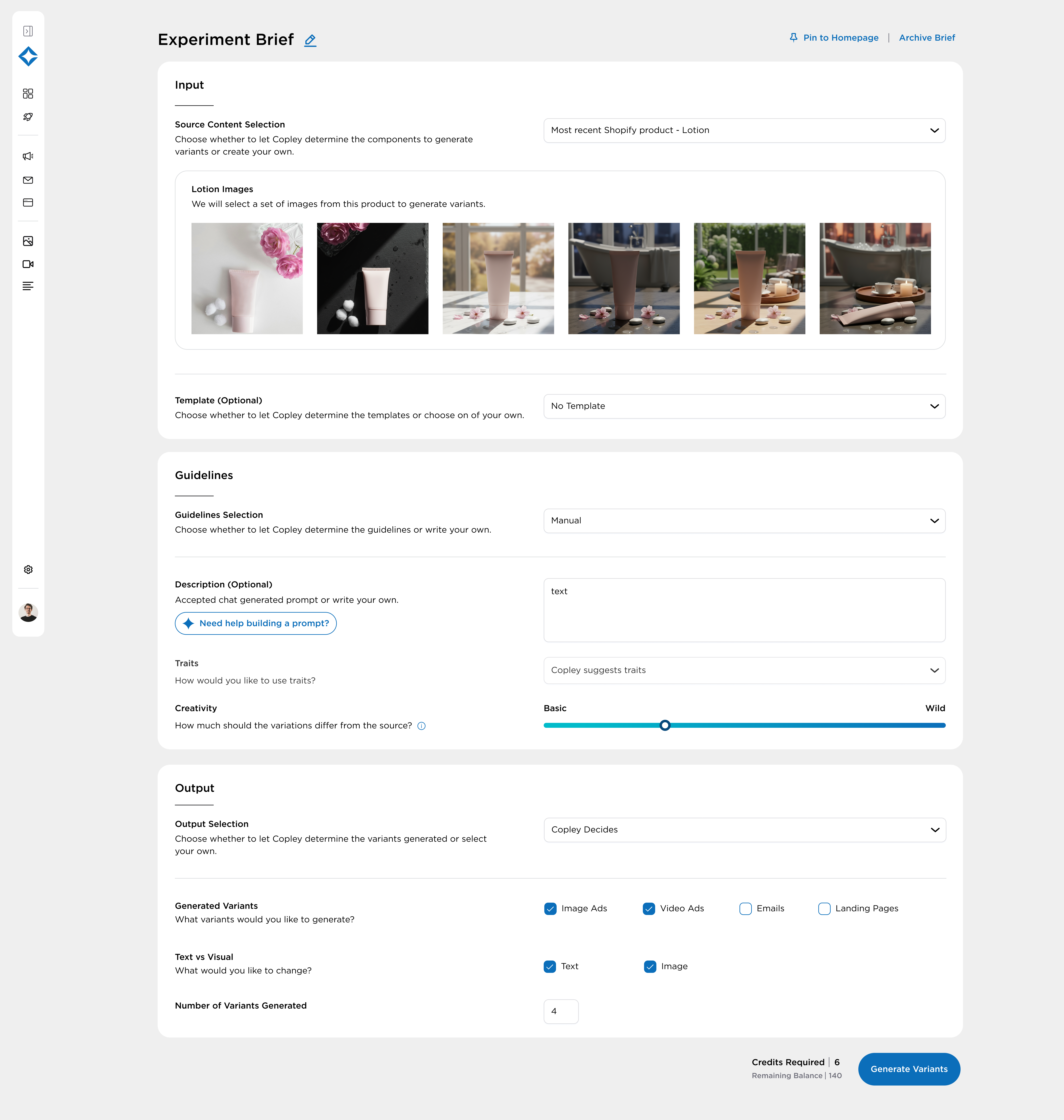
The original brief was a single long-form page — source content, a creativity slider (Basic → Wild), output settings, variant count. Everything visible at once. The AI worked entirely in the background; users made selections, hit generate, and received output. No freeform input. No back-and-forth. No indication the AI had interpreted anything. It treated ad creation like a form.
Gen 2 — October 2025
Adding a voice — but in the wrong place.
Gen 2 — 8-Step Wizard
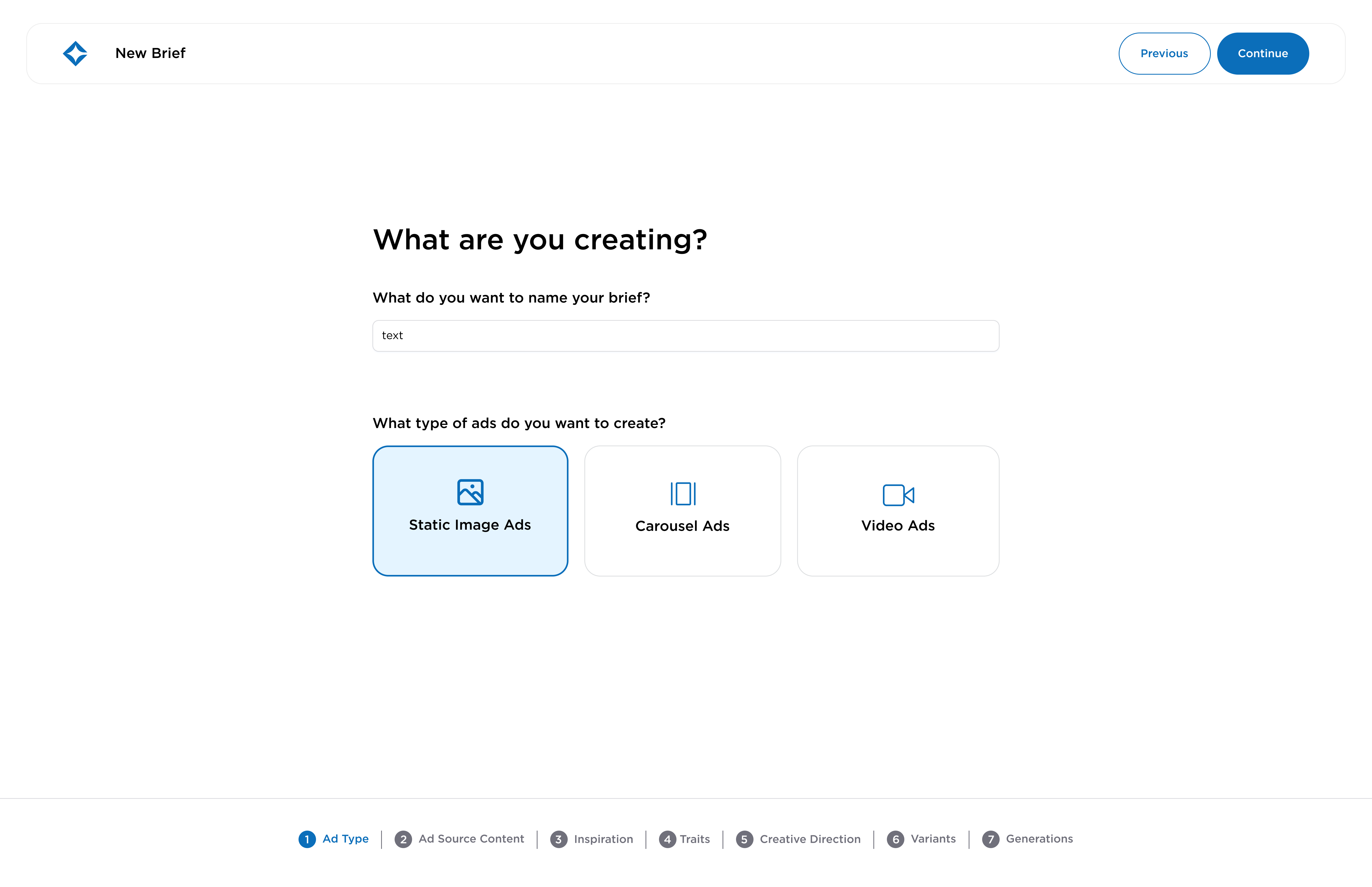
The second generation broke the single page into a 8-step wizard: Ad Type → Ad Source Content → Ad Source → Inspiration → Traits → Creative Direction → Variants → Review. The most significant addition was Step 5: a freeform Ad Concept field where users could describe the brief in their own words, paired with their Brand Kit.
But users immediately routed to that one field — rushing through steps 1–5 to get there, then iterating in the prompt box, completely bypassing the structured inputs. The wizard was 8 steps. The real interaction was happening in one box. When a system provides both structured and free-text input, users gravitate toward whichever feels most expressive.
Step 1 of 9
Gen 3 — 2026 (In development)
Making the AI the interface.
Gen 3 — Agent
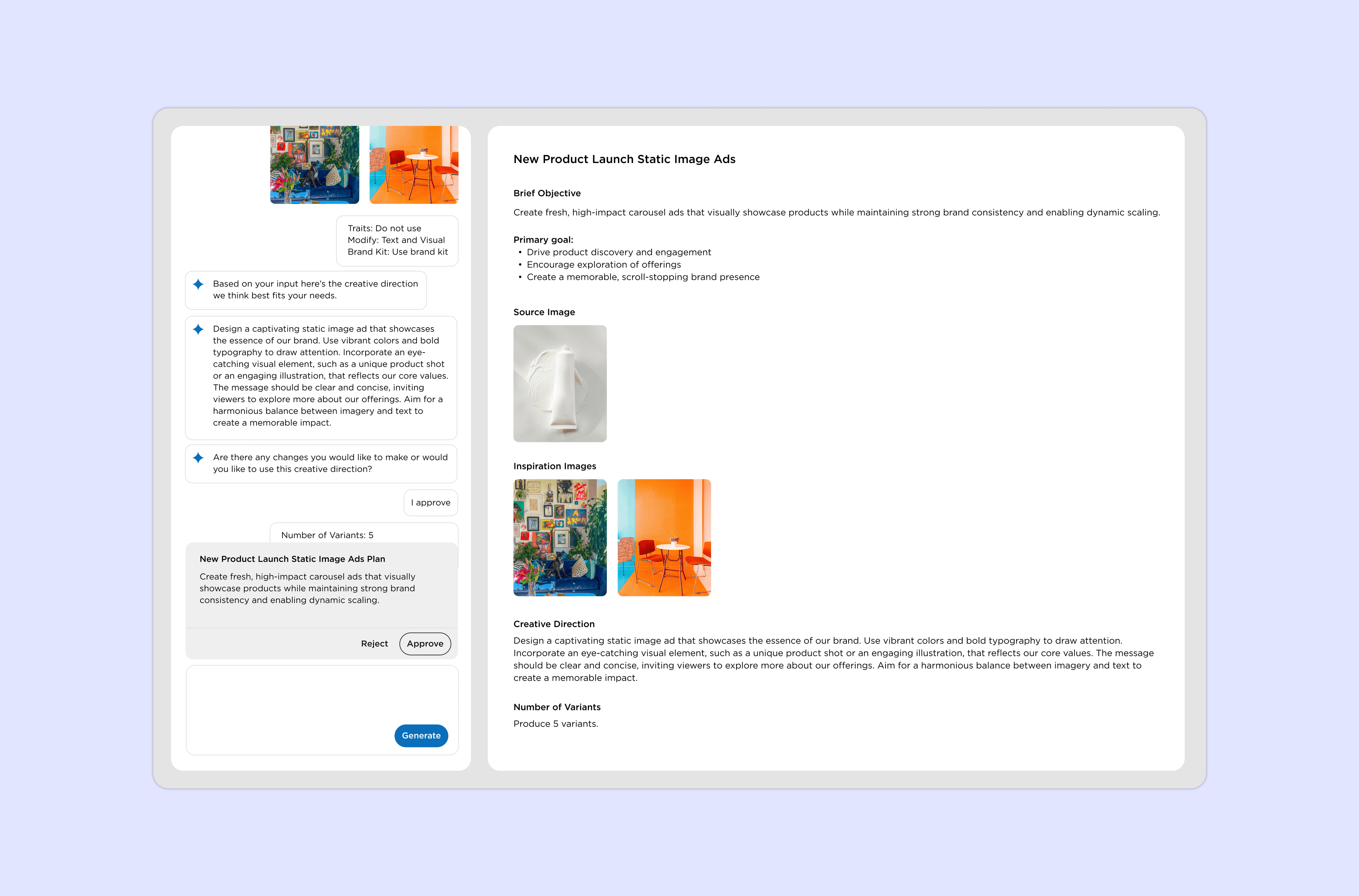
The third generation inverted the mental model entirely. Instead of a form that ends in AI, it's a conversation that begins with AI. A chat-based agent moves through the brief collaboratively — mixing quick structured inputs (image source, brand kit, traits) with open prompts (inspiration, concept direction). Then, crucially, the agent proposes the creative direction itself. It surfaces a full draft brief based on everything collected and asks: “Are there any changes you'd like to make, or would you like to use this creative direction?”
The user can edit, redirect, or simply say “I approve.” The cognitive load shifts dramatically — instead of starting from a blank box, the user reacts to a proposal. Curation is faster, lower-stakes, and more collaborative than creation from scratch.
Design Decisions
Outcome
From tool to collaborator.
Outcome
The Gen 3 conversational agent was presented internally and launched to clients, who described the experience as briefing a creative collaborator rather than operating a tool. We saw an increase in ad content creation through Copley. Ads were being generated 3x more daily than before.